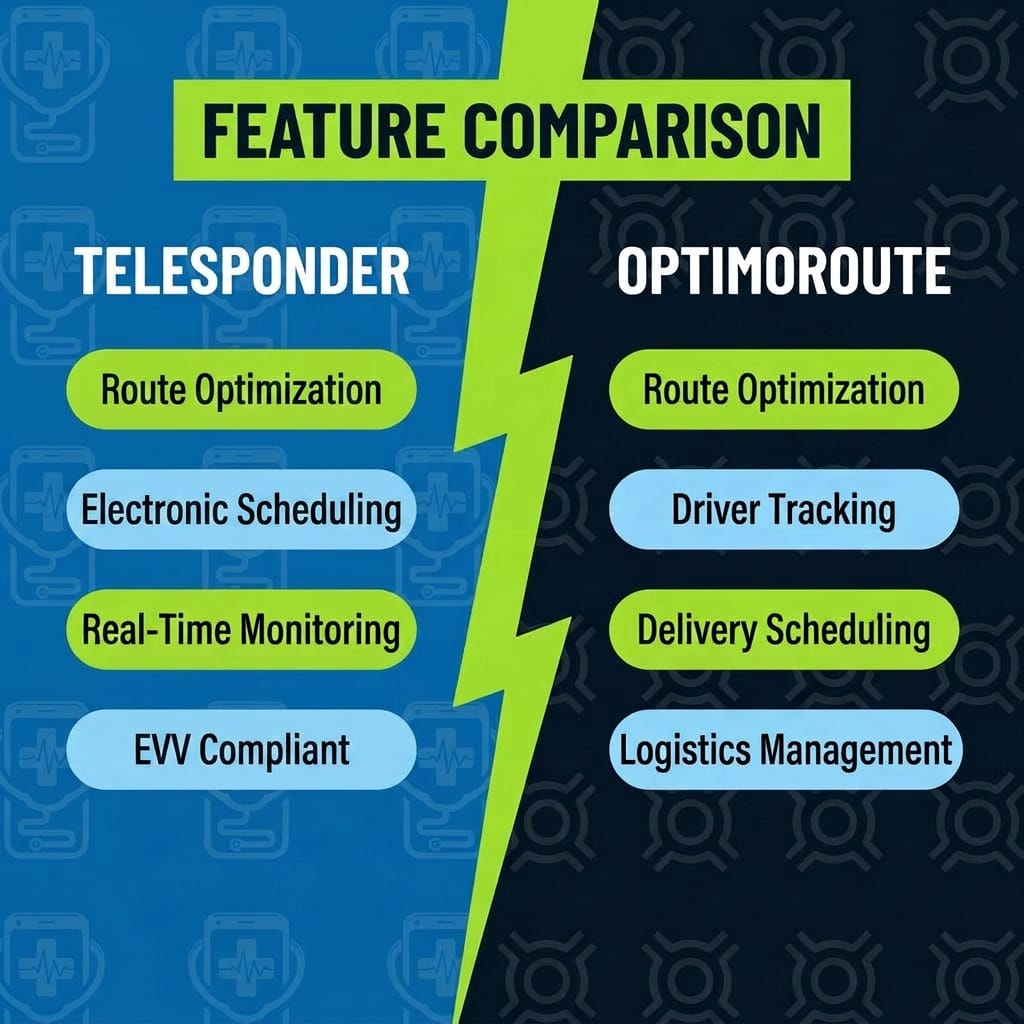
A large part of home care happens on the road. Every unnecessary mile is time taken away from patients. OptimoRoute is one potential solution. Designed primarily as a logistics platform, it optimizes the journey between multiple locations, reducing the time spent on the road.
That sounds like a dream — and it can be a big help.
In fact, by inputting your destinations, it will automatically plan the most efficient route and schedule. Many home care providers have adopted it to plan routes and daily schedules. The problem is that it doesn’t understand the industry-specific challenges of patient care, whether that’s caregiver autonomy or flagging unauthorized overtime visits.
Below, we take a closer look at OptimoRoute, highlighting what works, what doesn’t, and potential alternatives for home care.
Home Care Scheduling Is More Complex Than Route Planning
Home care is not the same as a logistics company. While many challenges come from getting coordinators to the right place at the right time, it’s not as simple as dropping off a package from Amazon.
It is a delicate balance between caregiver availability and patient needs.
Caregivers are balancing patient dignity, legal compliance, and constant communication with families and their wider team.
You can’t rush a patient who’s struggling to wash themselves. Nor can you handwave away a conversation with a family member because the app tells you you’re due across town in 30 minutes.
Compliance is another big factor. While a photograph of a package by the doorstep is enough confirmation for most logistics platforms like OptimoRoute, it’s not enough in home care. EVV (electronic visit verification) is necessary at every appointment and provides a clear audit trail — something auditors will check for.
What OptimoRoute Does Well (And Where It Falls Short For Home Care)
Where OptimoRoute Works
OptimoRoute isn’t a purpose-built home care software. It’s a logistics platform, and that’s where it excels. It offers:
- Dynamic route planning and real-time adjustments. Once it understands your stops and schedules, it always provides the most efficient route. Log a delay, and it adjusts in real time, so that an organization’s entire network is optimized.
- Vehicle capacity. For delivery companies, this is a big win. It ensures that each vehicle is as close to capacity as possible for each journey, saving money on fuel. Not quite as important for home care.
- Proof of delivery. The app automatically logs each delivery, letting the driver capture a photograph and timestamping the moment.
Where It Breaks Down for Home Care
OptimoRoute isn’t trying to be a caregiver scheduling app. It’s just that many organizations have adopted it as one. That means it struggles in a few key areas:
- No native EVV compliance. There is no built-in Electronic Visit Verification (EVV) system. Proof of Delivery captures a timestamp and location, but it doesn’t cover the EVV requirements under the 21st Century Cures Act.
- No caregiver-patient matching tools. The platform can assign routes, but it doesn’t account for care-specific factors like patient needs, caregiver skills, preferences, or continuity of care.
- No overtime or authorized hours alerts. There’s no mechanism to flag visits that exceed approved care hours, which can lead to billing issues, audit failures, or unexpected costs.
- No caregiver scheduling autonomy. Caregivers can follow routes, but they don’t have meaningful control over their schedules — such as viewing open shifts, setting availability, or managing changes in real time.
Why General Route Optimization Tools Struggle in Home Care
General route optimization tools are the default option for many home care agencies. Because of the overlap between logistics and home care, these tools can seem like a reasonable fit at first. That means treating caregivers like drivers and appointments like deliveries.
This isn’t just an issue with OptimoRoute. In fact, it’s very good at what it does. But it’s primarily designed for efficiency, not care delivery. Caregivers might spend hours on the road, but they’re not dropping off packages. They’re supporting vulnerable people with their everyday needs.
And it’s those differences where route optimization tools struggle most in home care.
They don’t understand:
- Visit types
- Care plans
- Authorization limits
Unless the system is built for patient communication, care planning , and handling emergencies, it won’t stand up to the daily challenges of home care. It’ll fail patients just as they need help most.
What Home Care Agencies Actually Need from Software
Home care agencies don’t want to abandon the OptimoRoute basics. They want route optimization and help with scheduling. But they want these features to be customized for their industry.
These personalized features include:
- EVV compliance. Accurate GPS-based clock-ins that meet the requirements of the 21st Century Cures Act. These records can then be pulled before an audit, reducing administrative paperwork.
- Mobile access. Caregivers are always on the go. They can’t head back to the office to complete their records or respond to patients. Any home care software must be mobile-first.
- Real-time communication. Caregivers, coordinators, and families have to talk to each other in real-time. Centralizing these conversations means everyone stays informed, aligned, and responsive.
- Automated overtime alerts. Visits that are approaching or exceeding authorized hours are flagged in real time, allowing coordinators to step in early and prevent compliance issues, billing errors, or unnecessary costs.
Telesponder as a Purpose-Built Alternative
Telesponder is a platform designed by caregivers, for caregivers. Instead of cookie-cutter tools adapted from logistics software, every aspect of Telesponder is built around real care workflows.
The biggest differences lie in compliance, the unpredictability of patient needs, and the importance of caregiver morale. Home care software can’t afford to fall short in these areas. It needs to empower teams — reducing paperwork, simplifying workflows, and acting as a support system, not another burden for caregivers.
That’s most evident in how Telesponder combines scheduling, routing, and EVV into a single system. With conventional route optimization platforms, EVV is often treated as a separate layer, and schedules lack flexibility for real-world care demands. Here, everything works together — aligned with how home care actually operates.
Key Features That Set Telesponder Apart
It’s no accident that Telesponder’s core features match the main needs of home care agencies. Only by doing the job ourselves could we understand what data agencies want to collect and what factors increase the risk of caregiver burnout.
That’s what we set out to support.
Automated Trip Logs & Mileage Calculations
Each trip isn’t just logging the arrival and drop-off. Telesponder logs:
- EVV data. Geofenced clock-in and clock-out events verified against the patient’s physical location.
- Mileage data. Automatically tracks and calculates caregiver travel for reimbursement — minimizes disputes and manual logs.
It also flags visits that are approaching or exceeding authorized hours so coordinators can see in real time where a violation is about to occur. That prevents thousands of dollars in billing penalties and Medicaid audit findings.
Home Care Route Optimization
Telesponder’s routing intelligence understands the realities of home visits. It considers patients’ preferences for appointments, caregiver travel patterns between multiple clients, and geographic challenges of a caregiver’s caseload.
Combining this data creates the best possible route that’s not just right for a delivery driver, but a caregiver working in the field.
Centralized Communication
Communication covers a lot of the issues that arise in home care. Everything from appointment cancellations to emergencies can get lost in a blizzard of emails and texts. Telesponder provides a centralized communication hub, so families have direct access to their assigned care team and coordinators and can liaise quickly with caregivers.
There’s no confusion or hunting for old messages. Everyone is always on the same digital page.
Real-Time Metrics and Insights
Coordinators must adapt to the constantly changing realities of home care. That means knowing where their team is, how their day is moving, and if there are any emergencies.
Telesponder delivers real-time metrics and insights at a glance. They can then support caregivers who are falling behind or make use of a team member who’s got a bit of extra capacity.
Home Care Software That Goes Beyond Route Optimization
Choosing the right system isn’t just about efficiency.
It’s about supporting the people delivering care, and the people relying on it.
Route optimization matters. But home care depends on trust, continuity, and the ability to respond when things don’t go to plan.
Tools like OptimoRoute can help with parts of the journey. But when it comes to the full picture — compliance, communication, and real-world care delivery — agencies eventually need something built for the job.
That’s where purpose-built platforms like Telesponder come in. Not as a replacement for efficiency, but as a system that actually understands the work (and people) behind it.
If you’re exploring alternatives, get in touch at [email protected] to see how it fits your agency.